 ← EXCELITY LABS
Bridging
Mission
Data Silos.
Ask once. Answer across every connected system.
A mission environment keeps its data in ArcGIS layers, REST and GraphQL services, STAC catalogs, partner feeds and planning systems — each with its own authentication, query language and resident expert. Gangplank reaches all of them from one place, translating a plain-language question into the right call to each source and normalizing what comes back. No ingest. No copies. No integration project per source.
The data exists. Reaching it is the problem.
Correlating across operational systems, APIs, geospatial services, sensor platforms and partner networks is a daily requirement — and most organizations still do it by hand, through disconnected ecosystems that each demand their own specialist.
Geospatial layers in ArcGIS. Logistics through REST. ISR through STAC catalogs. Partner intelligence, infrastructure status and planning data across platforms that never meet. Every one introduces its own authentication model, query method and response structure.
To ask which assets sit in a given region, an analyst first has to know which system holds the answer, how to authenticate to it, what query format it takes and how to read what comes back. That bottleneck shuts non-technical stakeholders out of their own data.
Even with access, there is rarely one operational picture. Correlating ISR, geospatial layers, infrastructure and mission event streams means manual effort across disconnected tools. Protocol expertise becomes the price of a single answer.
Onboard. Federate. Ask.
Gangplank is a federated access and semantic normalization layer — not a platform to migrate onto. It sits alongside the systems already running and puts a single query surface in front of them.
Point it at an endpoint and it discovers the schema, fields, capabilities and spatial extent for well-known protocols. AI generates readable field labels, descriptions and synonyms so the data can be searched in ordinary words.
typically under 5 minutesAn adapter architecture puts one common interface over incompatible systems — standardizing query execution, authentication, geospatial operations, response mapping and pagination. Source data is brokered in place, never copied.
9 protocols out of the boxQuestions go in as chat. Gangplank translates each one into the right API call per source, handling authentication, pagination and normalization. Each message builds on the last, so filtering happens through conversation.
for anyone who can type a questionThe filter is the conversation.
Each message carries the last one's context, so an analyst narrows toward the answer the way they'd talk it through — rather than rewriting a query against a new system each time.
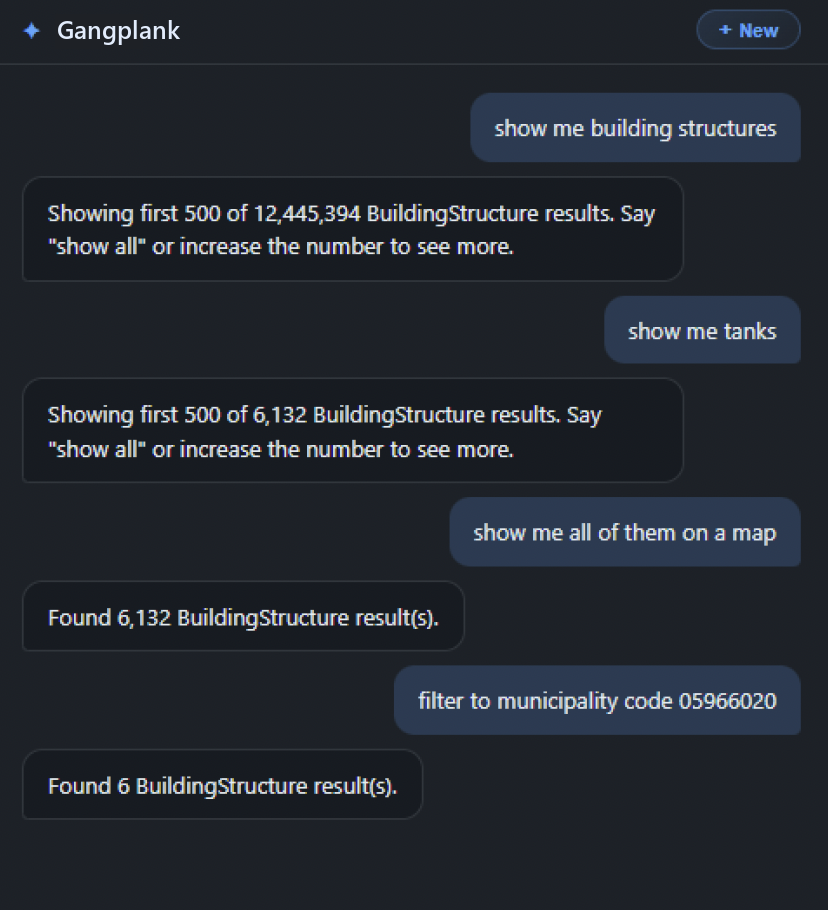
No protocol-specific tooling. The same four questions would otherwise mean four different query languages, four authentication models and four response formats to reconcile by hand.
Bounding-box, polygon and radius searches are translated automatically into each source's native geo query format. Temporal filters are rewritten to whatever that source expects — ISO 8601, Unix timestamps, or SoQL date expressions.
Drop a pin on the map and it reverse-geocodes to a street address, then takes context at every level above it: street, neighborhood, city, state, country.
Where, when, and how things connect.
Three dimensions of analysis over the same federated result set, in four views that switch instantly from chat or from the interface.
Geospatial
First-class geospatial support — maps, globes and location-aware queries — with bbox, polygon and radius searches translated per source. Non-spatial sources work equally well.
Temporal
Filter and sort by time across any source. Temporal fields are detected automatically during onboarding, and date filters are rewritten into each protocol's native format.
Relational
Where sources share identifiers, locations or time windows, the relationship graph can surface those links — turning isolated records into a connected picture.
Sortable and filterable, with smart column formatting — URLs as links, image fields as thumbnails.
Results plotted with interactive markers. Pin drop for location queries; search boundaries drawn automatically.
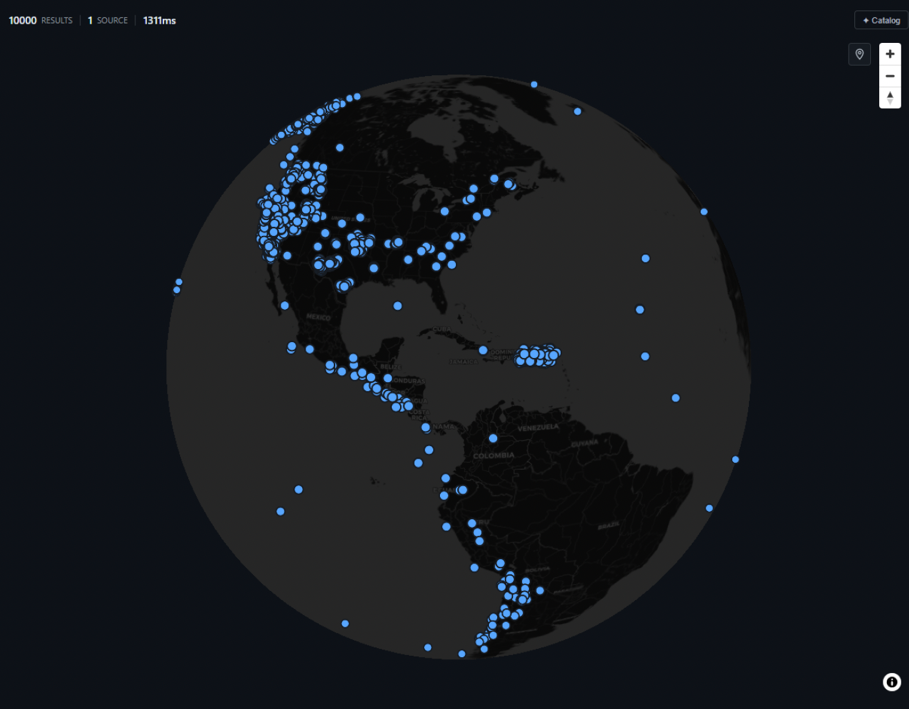
Full globe projection for worldwide datasets, with interactive rotation and zoom.
Connections between entities that tables and maps don't reveal.
Against the traditional approach.
| Capability | Traditional approach | Gangplank |
|---|---|---|
| Query interface | Protocol-specific APIs; custom code per source | Natural language, across all sources at once |
| Onboarding | Weeks of integration work per source | Under five minutes, AI-assisted |
| Analysis | Geo and temporal implemented per source | Unified geospatial, temporal and relational |
| Visualization | Separate tools for maps, tables and graphs | Table, map, globe and graph — switched instantly |
| Users | Developers only | Anyone who can type a question |
| Context | Each query starts from scratch | Conversational; filters build on prior results |
| Authentication | Managed per user, per source | SSO; source credentials handled centrally |
A query layer, not another repository.
Gangplank brokers access rather than accumulating it. Source data stays where it is, under the ownership and governance model it already has.
- Reduces data duplication
- Preserves authoritative source ownership
- Minimizes storage overhead
- Supports existing governance models
- Simplifies integration across distributed systems
Authentication and access are centrally controlled through Keycloak-based SSO and role-based access control, while source-specific credentials stay encrypted at rest.
- NestJS API server
- React front end
- Keycloak authentication instance
A modular deployment model built for environments where systems, partner integrations and data feeds change faster than integration budgets — so new sources can be brought on with minimal engineering overhead.
Connect a source once.
Normalized data is exposed through interfaces each kind of consumer already speaks — so onboarding a source serves all of them at the same time.
It's in active development in the lab and not yet in pilot. The white paper is the fullest picture of the capability today; if the problem it describes is one you're carrying, we'd like to hear about your environment.
Read the white paper.
The full capability, architecture and mission use cases — in eleven pages.
Download Excelity-Gangplank.pdf